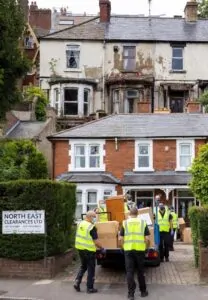
Northumberland house clearances often come with unique challenges. The properties range from coastal cottages in Seahouses to rural farmhouses near Rothbury, from Victorian terraces in Morpeth to modern homes in Alnwick. Each property type brings its own collection of unwanted items. Our Berwick and Hexham teams understand local property variations.
Last month, we worked with a family clearing their elderly mother’s house in Wooler. She’d lived there for 60 years, and the house contained everything from 1950s furniture to garden equipment to decades of household items. The family didn’t know where to start with deciding what to keep, what to donate, and what to dispose of.
Here’s how to handle unwanted items during Northumberland house clearances – from coastal properties to rural homes, from family heirlooms to general household waste. Learn more about our house clearance services.
Understanding Northumberland Property Types
Northumberland’s diverse property types affect what you’ll find during clearances:
The coastal properties in Seahouses, Bamburgh, and Alnmouth often have holiday rental contents – multiple sets of bedding, beach equipment, outdoor furniture, and items that accumulate from tourist use.
Rural properties near Rothbury, Wooler, and Alwinton typically have farm equipment, tools, garden machinery, and practical items that rural residents accumulate over decades.
The market towns of Morpeth, Alnwick, and Berwick have family homes with typical household accumulations, but often with more space for storage in lofts, garages, and outbuildings.
Each property type requires different approaches to handling unwanted items.
Sorting Before Deciding
The biggest mistake people make is rushing decisions about unwanted items. During that Wooler clearance, the family wanted to clear everything quickly, but they regretted it later when they realized they’d disposed of items with sentimental value.
Start with three simple categories:
- Definitely keep – items you’re certain about
- Need to decide – items that require more thought
- Clear – items you’re ready to remove
Even if you only sort one room this way, it creates a system for the whole house. We often find that once people start sorting, they become more confident about their decisions. Contact our Northumberland team for sorting guidance.
Local Donation Options in Northumberland
Northumberland has good options for donating unwanted items, but they vary by area:
Morpeth has several charity shops that accept furniture and household goods. Alnwick has community reuse schemes. Berwick has local furniture projects that help families in need. Check Northumberland County Council for local donation options.
During that Wooler clearance, we found furniture in excellent condition that could go to the Northumberland Community Reuse Project. We also found books that were perfect for the local library, and kitchen equipment that could help community groups.
Rural areas sometimes have fewer donation options, but community groups often appreciate useful items. We’ve taken garden tools to allotment projects, kitchen equipment to village halls, and books to mobile library services.
Recycling Across Northumberland
Northumberland’s recycling facilities are spread across the county, which affects how clearances work:
The main recycling centers at Alnwick and Morpeth accept most materials. There are smaller facilities in Berwick and Amble. Rural areas may have limited local recycling options, which means transporting items further.
During clearances, we typically find:
- Metal items – old radiators, broken appliances, garden tools
- Wood and timber – especially in rural properties
- Electrical items – WEEE recycling at main centers
- Garden waste – composting facilities available
- General household waste – landfill as last option
Professional clearance companies know which facilities accept what materials and plan routes efficiently across Northumberland’s large rural area.
Special Items: Furniture and Appliances
Some unwanted items require special handling:
Upholstered furniture now has specific disposal requirements due to POPs regulations. We cleared a house in Alnwick last year where we found several old sofas that needed to go to specialist facilities rather than general landfill.
Fridges and freezers contain hazardous materials and need specialist disposal. We often find these in rural properties where people keep spare appliances in outbuildings.
Large garden machinery – lawnmowers, chainsaws, agricultural equipment – may contain fuel and oil that need careful handling before disposal.
Sentimental and Valuable Items
Northumberland family homes often contain items with local historical or sentimental value:
We cleared a house in Berwick last year where we found photographs and documents related to the town’s fishing industry. Instead of disposing of them, we connected the family with the local heritage center.
In Rothbury, we found agricultural equipment that was historically significant. We helped the family identify items that local museums might be interested in.
It’s worth taking time to identify items that might have local historical value before clearing them.
The Rural Challenge
Rural Northumberland clearances present specific challenges:
Access can be difficult – narrow country lanes, limited parking, properties that are hard to reach with large vehicles.
Distance to disposal facilities means more planning and higher transport costs. A clearance in Wooler might require traveling to Alnwick or Morpeth for proper disposal.
Weather can affect rural clearances – winter conditions can make access difficult, especially in more remote areas.
Local clearance companies understand these rural challenges and plan accordingly.
Coastal Property Considerations
Coastal properties have their own unwanted item challenges:
Salt corrosion can make garden furniture and metal items deteriorate faster, affecting whether they can be reused or recycled.
Beach equipment – windbreaks, deck chairs, fishing gear – accumulates in coastal properties and may need specific disposal routes.
Holiday rental contents often include multiple sets of items that may be worn but still usable.
Legal Compliance
Here’s crucial for Northumberland clearances: you’re legally responsible for your waste until it’s properly disposed of.
We’ve seen cases where people clearing rural properties hire unlicensed operators who dump waste in country lanes or on farmland. The landowner receives the fine, not the operator.
Proper waste carriers are registered with the Environment Agency. Our license number is CBDU 486667. You can check any company’s license on the public register.
Legal compliance is especially important in rural Northumberland where illegal dumping is more common and harder to detect.
When to Use Professional Clearance
Professional clearance makes sense when:
- You have mixed waste types and bulky items
- You’re working to a deadline (property sale, probate)
- You want responsible disposal without multiple trips
- The property is in a rural or hard-to-access location
- You’re dealing with a bereavement and need support
Professional clearance companies handle the sorting, transportation, and disposal, ensuring everything goes to the right facilities.
Service Coordination
If you need to handle unwanted items during a Northumberland house clearance:
- Start sorting before the clearance date
- Identify items that might have local value
- Consider access challenges for rural properties
- Choose a licensed waste carrier
Give us a call on 07868 666337 if you need help with unwanted items in Northumberland. We’ll ask about the property location, what types of items you have, and any specific concerns.
We cover all of Northumberland – from Berwick to Bellingham, from coastal villages to rural farms. We’re Environment Agency approved (CBDU 486667), fully insured, and our team are all DBS-checked.
We’ll help you sort unwanted items responsibly, ensuring reusable items find new homes and everything else is disposed of properly.